As tensions over North Korea's nuclear weapons program continue to mount, a group of human rights advocates who work with North Korean refugees has been telling American Christians they should help try to bring down that country's Stalinist regime.
Norbert Vollertsen, a German doctor; the Rev. Douglas Shin, a Korean American minister from Los Angeles; and Chun Ki-Won, a South Korean evangelist -- accompanied by a refugee from North Korea -- have been addressing congregations, saying churches could undermine the North Korean government by making the plight of the isolated country's population a priority.
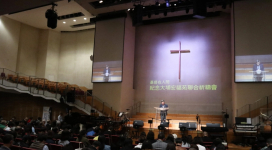
Their message has been enthusiastically received by some in the Los Angeles area's large Korean immigrant population.
Los Angeles dentist Jin-Hwan Choi was so moved when the group spoke recently to a church in Koreatown that he took visiting North Korean defector Yoo Sang-Jun, a man he hadn't met before, home when he learned that he needed a place to stay while in the city.
"We have to do something," Choi said. He plans to lobby members of Congress to support legislation sponsored by Sens. Sam Brownback (R-Kan.) and Edward M. Kennedy (D-Mass.) that would make it easier for North Koreans to seek asylum in the United States.
Henry La, a retired Los Angeles social worker, said he was especially stirred by Vollertsen's comment that Christians could not afford to remain silent lest they allow history to repeat itself.
"My heart aches for the people in North Korea," La said. "Even people who aren't Koreans will feel as I do, if they heard what I heard."
Vollertsen, who spent 18 months in North Korea working for a German relief agency before he was banished, says conditions there are reminiscent of those during the Nazi era in his native land.
"As a German, I cannot keep silent. I must learn from history," he said. "As an emergency doctor, I cannot wait for 20 or 50 years for reunification" of North and South Korea. "I have to make an operation soon, because they are dying and starving."
Christian churches in the United States have the ability to change those conditions, he tells his audiences.
Pyongyang, the North Korean capital, used to be called the "Jerusalem of Asia" because of its many churches, he says, but the North Korean regime has systematically persecuted the nation's Christian residents.
"Kim Jong Il seems to know about the power of Christianity," Vollertsen said of the North Korean leader. "Therefore, he tries to eliminate" Christians. "So let's prove that he is right. Let's show the power of Christianity to him."
Human rights groups and government officials estimate that since 1996, more than 2 million North Koreans have died of starvation, related disease and persecution. Rights organizations estimate that as many as 300,000 North Koreans may be in hiding, primarily in China, but also in Mongolia, Russia, Vietnam, Laos, Cambodia, Myanmar and Thailand.
Vollertsen, Shin and Chun work to help get refugees who have fled North Korea to safety, an effort they say is a calling from God. Like many Korean and Korean American missionaries who work in the Korean-Chinese border area, the men see the region as a promising mission field. Chun said about 80% to 90% of North Korean refugees become Christians there.
Each of the three has taken considerable risk to pursue his calling.
Vollertsen, who gave visiting foreign journalists an unsanctioned tour of Pyongyang in 2000 when then-Secretary of State Madeleine Albright visited the country, believes he is on a North Korean hit list. To see his parents during a recent trip to Germany, he met up with them in a remote area, he said.
Shin used to harbor North Korean refugees in an apartment in the Mongolian capital of Ulan Bator. After his second arrest in Mongolia, he relocated his Korean Peninsula Peace Project to his one-bedroom apartment in Los Angeles.
Chun was imprisoned in China in December 2001 for transporting refugees. After his release last August, he was barred from the country. He continues to run his evangelical outreach for North Koreans out of Seoul and supports refugees in China with housing, food and travel expenses, working with his many contacts there.
Both Shin and Chun say they repeatedly escaped danger in their refugee efforts; they credit their survival to "miracles."
During a seven-day train journey through China in 2000 with 20 North Korean refugees, including Yoo, Chun said, he prayed that God would "blind the eyes" of police guards who check IDs. Despite 15 checkpoints, the guards asked only to see Chun's identification, not those of the refugees, he said.
Shin said he walked away without a scratch when a taxi in which he was riding in Mongolia flipped over three times after skidding on ice.
Such stories, they hope, will inspire others to join the cause. "So many people told us they did not know" how bad it is in North Korea, Chun said. "Once they heard us, they promised to help -- to get involved."
By Albert H. Lee
chtoday_editor@chtoday.com
N. Koreans' Dire Plight Described
By
GH Newsroom